
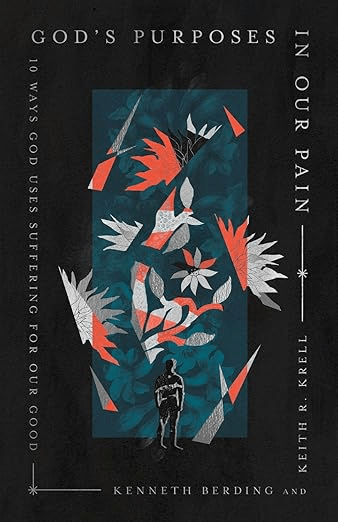
For today’s post, I’ve extracted twelve brief passages from my new book (with co-author Keith Krell): God’s Purposes in Our Pain: 10 Ways God Uses Suffering for Our Good. I hope you’ll receive spiritual encouragement from these short excerpts—though, of course, the impact will be greater if you can get a copy of the book and read these words in context.
What Does “Why” Mean?
“So what does why mean? Ken speaks a foreign language that makes it a lot easier to answer this question. That language uses two question words in place of our one English word why. Each of the two words, though, is nuanced differently from the other. One looks backward: ‘From what cause?’ The other looks forward: ‘To what end?’ English can make this discussion confusing by combining both ideas into a single word. As a result, many of us unknowingly struggle even to know exactly what question we’re asking when we ask why God allows suffering.”
The Job of the New Testament
“Second Corinthians is sort of the book of Job of the New Testament. But unlike Job, 2 Corinthians offers actual answers to the question of why God permits his children to suffer.”
Life is Pain
“The great theologian Westley from The Princess Bride once commented, ‘Life is pain, Highness! Anyone who says differently is selling something!’”
Comfort as Spiritual Strengthening
“The Greek word translated ‘comfort’ in these verses means more than merely soothing us when things are hard. It means ‘to help by giving encouragement’ or even ‘to instill someone with courage or cheer.’ In this passage, the emphasis is on God spiritually strengthening us during our sufferings so that we will be able to spiritually strengthen those who suffer. So instead of comfort making us comfortable, Paul emphasizes that God’s comfort makes us spiritually strong.”
The Importance of Trust
“There are probably a thousand reasons why God allows suffering to enter the lives of his children. But one of the most common reasons—and one of the most fundamental—is stated in 2 Corinthians 1:9: ‘Indeed, we felt that we had received the sentence of death. But that was [in order] to make us rely not on ourselves but on God who raises the dead.’ One of the main purposes for divinely permitted suffering is to learn to trust in God and to stop trusting in ourselves. It is more important that we learn to trust deeply in God than live a life free from suffering. Trust is that important.”
Golden Repair
“Kintsugi is a Japanese term that means ‘golden repair.’ This art form involves fixing broken pottery with gold, making the cracks visible instead of hiding them. Kintsugi artists believe that damaged objects have special beauty; the difference between their original perfect state and their current imperfections adds to their appeal. This technique has become well known in Japanese art, and some artists even break pottery on purpose so that they can later repair it with gold, which is meant to celebrate its flaws. Kintsugi provides a beautiful illustration of what God does in and through us. He takes cheap and fragile pottery and infuses it with gold, which holds the fragile broken pieces together. In Paul’s analogy, the treasure—that is, God’s glory in the gospel—emerges from inside us, from simple, inexpensive, and fragile pots.”
Manifesting Jesus
“Oh, how much we long for the life of Jesus to be manifest through us! We don’t desire suffering for its own sake. But when we do suffer, we long for others to see Jesus in us, despite our weak, broken, and hurtling-toward-death bodies. And we long for Jesus to be displayed in you, too.”
Waking Up in the Presence of Jesus
“Many of us have undergone surgery at some point. An anesthesiologist enters the room, starts an IV drip, and puts us to sleep. We fall asleep in one room. When we awaken, we’re in a different room. The surgery is finished and we’re greeted by someone different than when we went to sleep. Similarly, when we pass from this life, we will awaken in a different yet much better place—and best of all, in the presence of Jesus!”
Supporting Others during Suffering
“Elephant researcher Virginia Morell makes a comment about elephants that could apply to the way Christians should support each other: ‘They help baby elephants stuck in mud holes, use their trunks to lift other elephants that are injured or dying, and even reportedly reassure distressed individual elephants with a gentle touch of their trunk.’ God uses suffering to spur us to help other Christians who are stuck in the mud, to aid those who are injured or dying, and to reassure distressed people with a gentle touch or hug.”
Accelerating Spiritual Growth
“As we’ve carefully observed other Christians suffer, we have come to believe that suffering accelerates the process of spiritual growth in a way that nothing else can, so long as those who are suffering remain receptive to whatever provisions God grants during their season of suffering.”
Counteract Conceit
“The early church father Irenaeus, writing about Paul’s thorn in the flesh only a little more than a century after Paul’s death, comments, ‘For there is nothing evil in learning one’s infirmities…rather it has even the beneficial effect of preventing him [Paul] from forming an undue opinion of his own nature.’ Despite his deep admiration for the apostle Paul, this early Christian writer recognized that even Paul was at risk of developing ‘an undue opinion’ of himself. Irenaeus understood, as we all should, that God used Paul’s chronic physical pain in a beneficial way to help him counteract conceit. If this was the case with Paul, certainly it will be the case for many of us.”
A Conduit for the Power of Christ
“What was Paul’s response to this message that God was not going to heal him but would increase his power through Paul’s weakness instead? Did Paul turn his why into a whine? Did he stubbornly insist that God remove the thorn? Did he permit himself to sink into a long-term seething anger catalyzed by unmet expectations? No. He responded, ‘Therefore I will boast all the more gladly of my weaknesses, so that the power of Christ may rest upon me’ (12:9). Paul proclaimed that, going forward, he wouldn’t fight his weaknesses; he welcomed them so that he might become a conduit for the power of Christ.”
I would love for you to pick up a copy of God’s Purposes in Our Pain: 10 Ways God Uses Suffering for Our Good and share it with a Christian friend who is wrestling with the why-suffering question. I’ve been deeply helped by the truths from God’s word unpacked in this book, and I’m praying fervently that through it God will strengthen the faith of many brothers and sisters in Christ who are enduring pain of various kinds.

